
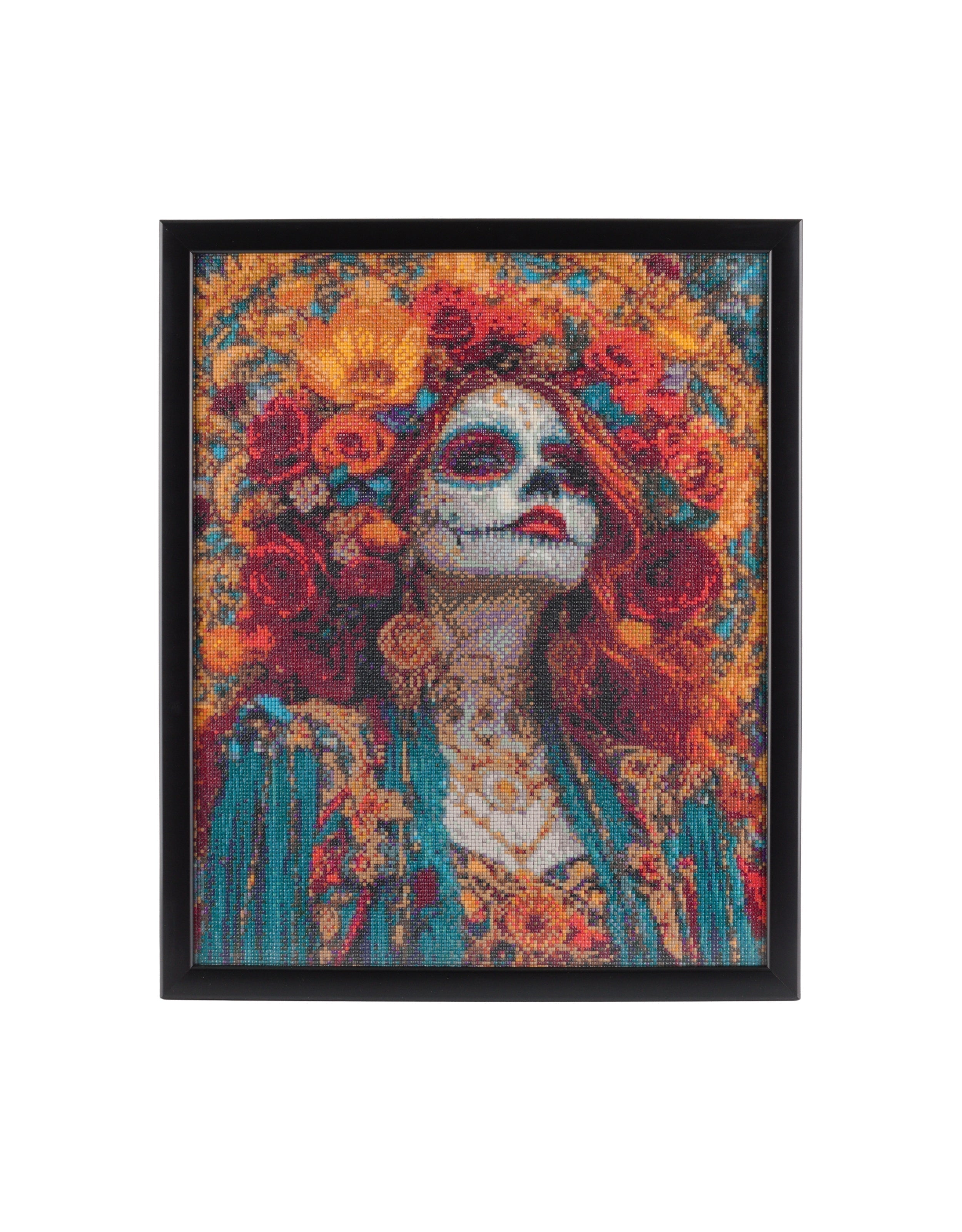
The Woman in Flowers
What I Learned About Freedom in Topo Chico Prison
She looks joyful.
Flowers crown her head, colors move freely across her face, and there is something almost playful in her expression. At first glance, she feels light. Alive. The kind of artwork that fills a space with warmth before you even know why.
But while I was working on her - slowly, patiently, placing facet after facet - she started to take me somewhere else. Somewhere I hadn’t visited in years. Somewhere I hadn’t planned to return to.
She brought back a memory.
A difficult one. A powerful one. One that changed forever the way I understand freedom.
The First Time Death Didn’t Feel Heavy
It takes me back to November 2018, to Mexico. I was part of a group of dancers invited to perform at the Santa Lucía Festival. Just days earlier, we had been in Mexico City during the Día de los Muertos celebrations. Coming from a different culture, I had never seen anything like it before.
The city didn’t mourn the dead - it celebrated them.
Skeletons made of flowers filled the streets. Altars overflowed with color. Faces were painted not to hide death, but to acknowledge it, to welcome it, to keep loved ones present. It was vibrant, emotional, deeply human. I remember thinking how strange and beautiful it was - how different from the quiet, heavy way we usually associate with loss.
At the time, I admired it.
I didn’t yet understand it.
The Fence That Changed Everything
A few days later, we traveled to Monterrey for the festival performances. One morning, we were told to be ready early. No explanation. No destination. We got on a bus and drove for a while, until it stopped in front of a massive concrete fence topped with barbed wire.
That’s when we were told where we were.
Topo Chico Prison.
It turned out that our performance was part of a government rehabilitation program connected to the Santa Lucía Festival. The idea was simple, and also strangely brave: bring art and culture into places where hope rarely enters. How effective that is, I still don’t know. But that’s how a group of dancers ended up preparing to perform inside one of the most terrifying prisons in Mexico.
Getting inside took hours. Biometric scans. UV markings on our arms. Full physical checks. Armed guards everywhere - weapons I had only seen in movies, faces completely hidden behind helmets and protective gear. Prisoners were moved close to us, chained at the legs, waist, neck, faces covered with masks.
After that day, airport security never felt excessive.
I remember standing there thinking: this is not a place meant for ordinary people.
And yet, we were there to dance.
We walked past cells where prisoners sat on the floor, cuffed, silent. We were dressed for a festival - skirts, sleeveless tops - completely normal outside, completely wrong inside those walls. The ground was stained with old blood marks. Behind the stage were small isolation rooms - cold, dirty, bare. Those were our dressing rooms.
When the prisoners finally sat in the audience, I felt something I had never felt before.
I had never seen human beings like that.
They were alive - but empty. No emotion. No curiosity. No anger. No hope. Their eyes didn’t look at us; they looked through us. As if something essential had already left them long ago.
While we danced, cockroaches scattered under our feet. Sometimes you could hear them crunch when you stepped wrong. The guards stood one meter apart, weapons ready, watching every movement. And still - we smiled. We performed. We gave everything we had.
It took discipline. It took control. It took strength to stand there and do what we had come to do.
When Freedom Was No Longer Abstract
When we finally left that place hours later, what I felt wasn’t just relief.
It was physical.
Every cell in my body reacted. I didn’t just know I was free - I felt it. Deeply. Viscerally. As if freedom itself had weight, temperature, texture.
That same night, we performed again - this time on the biggest stage of the festival, in the center of Monterrey, in front of thousands of people. Normally, I suffer from severe stage anxiety. My body shakes. My voice trembles. I feel sick before going on stage.
That night, something was different.
There was no fear. No hesitation. I was present. Grounded. Fully alive. It was the best performance of my life - not because it was perfect, but because it was real. Because for the first time, I truly understood what freedom feels like when it moves through your body.
Freedom is not a concept.
It’s not a word.
Freedom is the ability to choose - your mood, your actions, your direction. To step outside. To speak. To dance. To protest. To leave. To stay. To be in a bad mood simply because you can.
We use our freedom unconsciously every single day, until we see what life looks like without it.
That experience changed me forever.
Even now, when I catch myself complaining or feeling overwhelmed, I remind myself how lucky I am to have the choice to feel that way at all.
Years later, while working on this handcrafted crystal micro-mosaic artwork - this woman with flowers, this face painted like a skull - that memory came back to me with clarity. She doesn’t celebrate death. She celebrates life. Just like Día de los Muertos itself, she reminds us that those who are gone are remembered - and those who are here are meant to live fully.
This artwork is not about darkness.
It’s about gratitude.
About presence.
About freedom - not as an idea, but as an experience.
And yes - about churros. Because after that day, churros somehow tasted better. Everything did. Some memories leave sweetness behind, even when they come from places you'd never want to return to.
What The Woman in Flowers Holds
This unique handcrafted crystal micro-mosaic wall art doesn't exist to celebrate death. It exists to honor life.
She holds the visceral understanding of freedom - not as an idea, but as something you feel in your body. The awareness that being alive, truly alive with all its struggles and joys, is a gift many never fully experience.
She doesn't make you sad. She makes you present. She reminds you of the small, sacred choices you make every single day - choices others cannot.
This is what handcrafted crystal micro-mosaic wall art should do. Not fill space with beauty, but hold space for gratitude.
For Those Who Understand
This unique handmade wall art is for someone who knows that freedom is not a given.
For anyone ready to appreciate the daily miracle of having choices. For the person who has been through something that changed how they see the world - and wants a reminder of that shift.
For interior designers, this piece brings depth and meaning into a space. It's a conversation starter that goes beyond aesthetics - it asks questions about life, death, and what we take for granted.
For collectors, this is art with a story you can't replicate. A memory embedded in every facet. A truth whispered through every color.
For anyone curating a home that reflects their values, this painting carries a powerful reminder: To be alive - truly alive - is a gift.
Own The Woman in Flowers
She's waiting.
Crowned in marigolds. Painted as a calavera. Joyful in the way only those who understand both life and death can be.
This unique handcrafted crystal micro-mosaic wall art is for someone who has felt freedom leave a room and never wants to forget what it felt like when it returned.
The Woman in Flowers doesn't promise happiness.


